

Generative engine optimization, or GEO, is the practice of earning mentions, citations, and recommendations inside AI-generated answers. For hyperlocal businesses such as pest control, HVAC, and basement waterproofing, GEO has moved from a side experiment to a core visibility channel, often deserving a larger share of focus than traditional SEO alone.
The reason is simple. Nearly half of consumers now ask AI tools like ChatGPT for local business recommendations, according to BrightLocal’s Local Consumer Review Survey. The businesses those tools name are winning calls and bookings that never touch a traditional results page.
For two decades, local visibility meant one thing—a strong Google Business Profile and a spot in the map pack. That foundation still matters, but the data now shows it does not automatically carry over into AI search, and the gap is costing local businesses customers they never see.

How Many Customers Find Local Businesses Through AI?
Forty-five percent of consumers used AI tools to find local business recommendations in the past year, up from just 6% the year before, according to BrightLocal. That is a sevenfold jump in twelve months.
The same research shows that AI has already surpassed Yelp and TripAdvisor as a recommendation source. Only Google and Facebook rank higher, and Google’s share of local business discovery slipped from 83% to 71% over the same period.
Trust is climbing with usage. BrightLocal’s AI trust research found that 42% of consumers now trust AI recommendations as much as traditional reviews, though most still fact-check what AI tells them.
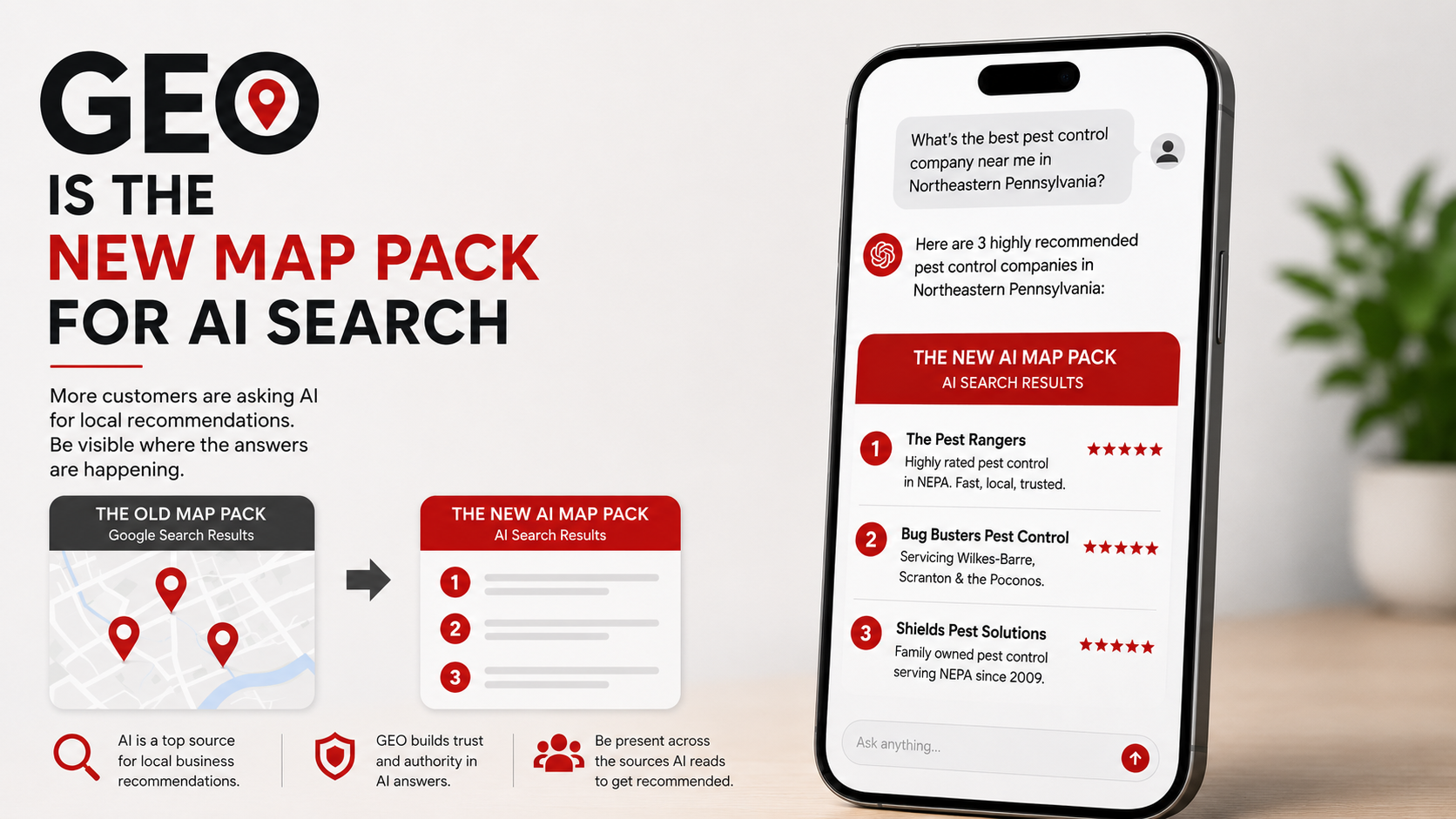
This matters because the customer who once scrolled the map pack now asks a chatbot for “the best pest control company near me” and gets three names. If your business is not one of them, the conversation ends before your website or profile ever loads.
Why Isn’t the Map Pack Enough Anymore?
Winning the map pack no longer means winning AI search. SOCi’s 2026 Local Visibility Index, which analyzed roughly 350,000 locations across 2,751 brands, found brands appeared in Google’s local 3-pack 35.9% of the time. ChatGPT recommended just 1.2% of those same locations. Gemini recommended 11%, and Perplexity 7.4%.
Search Engine Land summarized the finding bluntly, calling AI local visibility “up to 30x harder” than ranking in Google.
The overlap is just as revealing. Only about 45% of brands that lead in traditional local search also appeared in AI recommendations. More than half of the businesses winning the map pack are invisible when a customer instead asks an AI assistant.
How Much Do AI Search Results Actually Change?
AI search results change constantly, far more than traditional rankings. Research from Profound measured “citation drift” and found the sources AI engines cite can change by up to 60% in a single month, even for identical questions.
Local recommendations swing even harder. A study covered by Search Engine Land found AI recommendation lists repeat identically less than 1% of the time. Ask the same question twice and you will rarely get the same list of businesses.
AI answers are probabilistic, not fixed. There is no permanent number one spot to defend. Visibility comes from being consistently present across the many sources each engine reads, so your business keeps surfacing no matter how the answer shuffles.
That is a fundamentally different game than holding a map pack position, and it rewards breadth, consistency, and authority over any single ranking.
What Do ChatGPT, Gemini, Claude, and Perplexity Use?
Each major AI search engine indexes the web differently. That is a core reason results vary so much between platforms, and why a business can be visible in one assistant and absent from another.
ChatGPT
ChatGPT’s live web answers run through a Bing-powered index plus OpenAI’s own search crawler. Search Engine Land testing found that for local queries, ChatGPT pulls roughly 20 to 30 top results, then applies its own logic, favoring sources with clear ratings, no paywalls, and verifiable details.
- What to do: Claim and complete Bing Places, keep review platforms like Yelp and the BBB accurate, and publish pages that state services, areas, and pricing plainly. SOCi found business info was only about 68% accurate on ChatGPT, so consistency is the fastest win.
Gemini and Google AI Overviews
Gemini grounds its answers in Google’s live search index and Google Maps data. The same index powers AI Overviews and AI Mode inside Google Search. That is why SOCi measured 100% business profile accuracy on Gemini, compared with roughly 68% on ChatGPT and Perplexity.
- What to do: Your Google Business Profile and traditional local SEO transfer most directly here. Strong Google fundamentals feed Gemini almost one to one.
Claude
Claude runs its web searches through the Brave Search API, an independent index separate from both Google and Bing. Content that never gets indexed by Brave simply cannot surface in Claude’s cited answers.
- What to do: Keep your site fast, crawlable, and open to search bots, and earn mentions on established local and industry publications, which Claude leans on heavily when citing sources.
Perplexity
Perplexity built its own crawler and index, supplemented with third-party data. Its bot obeys robots.txt, so a site that blocks PerplexityBot is invisible there. Perplexity also tends to cite more sources per answer than any other engine.
- What to do: Confirm no crawler blocks, keep content fresh, and structure pages so individual sections answer specific local questions cleanly.
Where Should a Hyperlocal Business Start With GEO?
Start with the signals every engine reads, then layer on platform-specific work. The priorities below deliver the most AI visibility per hour invested.
- Lock down entity consistency: identical name, address, phone, categories, and service descriptions across your website, Google Business Profile, Bing Places, Yelp, Facebook, and major directories. Inconsistent data makes AI engines skip you.
- Build reviews everywhere, not just Google: SOCi found locations recommended by ChatGPT average a 4.3-star rating, and engines cross-reference multiple review platforms before naming a business.
- Publish direct-answer content: pages and posts that answer real local questions about cost, timing, and process in short, quotable sections. A structured approach like the three-tier blog strategy gives every post a job across the funnel.
- Add local proof: technician bios, certifications, neighborhood references, and localized scenarios that anchor your business as a real entity in a real place.
- Keep schema and crawlability clean: LocalBusiness schema, HTML pricing tables, fast load times, and zero accidental bot blocks.
- Track AI visibility monthly: ask each major engine your money questions and log which businesses get named. Search Engine Land’s GEO metrics guide covers the measurement side in depth.
These fundamentals are the same signals covered in ContentMender’s local SEO ranking factors guide and its breakdown of how GEO compares to SEO. The difference now is where they surface: inside answers, not just under them.
Should GEO Get a Larger Focus Than Traditional SEO?
For discovery, yes. The growth curve, the conversion quality, and the difficulty gap all point the same direction.
Semrush research shows visitors arriving from AI search convert at roughly 4.4 times the rate of traditional organic visitors, and Semrush projects AI search traffic will overtake traditional search for many sites by 2028.
Semrush’s 2026 AI Visibility Index, built on 126 million AI search prompts, adds the strategic answer: 81% of organizations that fully integrate SEO and AI visibility into one workflow reported more traffic or leads from AI platforms. Among teams treating them separately, only 36% could say the same.
So the honest framing is not “GEO” instead of “SEO”. It is GEO powered by SEO, with a growing share of attention on the AI side, because that is where local discovery is moving fastest and where the fewest competitors are showing up.
That is exactly how ContentMender’s Hyperlocal Lead Generation campaigns are built: Google Business Profile management, localized content, review growth, and AI-search visibility working as one system instead of separate line items.
The local businesses that treat AI mentions and citations as a primary goal today will own the recommendations their competitors are still ignoring.
FAQs
What is GEO for local businesses?
GEO, or generative engine optimization, is the practice of earning mentions, citations, and recommendations inside AI-generated answers from tools like ChatGPT, Gemini, Claude, and Perplexity. For local businesses, it means becoming one of the few names an AI assistant gives when a customer asks for a nearby provider.
Do map pack rankings help with AI search visibility?
Partially. SOCi’s data shows only about 45% of brands leading traditional local search also appear in AI recommendations. Google fundamentals transfer most directly to Gemini and AI Overviews, but ChatGPT, Claude, and Perplexity each read different indexes and weigh different signals.
Which AI search engine matters most for local businesses?
ChatGPT has the largest consumer usage, with 31% of consumers using it for business recommendations per BrightLocal. Gemini matters because it inherits Google’s local data. The practical answer is to optimize the shared signals, meaning consistent business data, broad reviews, and direct-answer content, so all four engines can find and trust you.
How often do AI search results change?
Constantly. Profound measured citation changes of up to 60% in a single month for identical questions, and research covered by Search Engine Land found AI recommendation lists repeat identically less than 1% of the time. Consistent presence across many sources beats chasing any single position.
Do reviews still matter in AI search?
More than ever. SOCi found locations recommended by ChatGPT average a 4.3-star rating, and AI engines cross-reference reviews from multiple platforms before naming a business. Review volume, recency, ratings, and owner responses all feed the trust signals AI relies on.
Can a small local business realistically show up in AI answers?
Yes. AI selectivity cuts both ways. Because engines recommend so few businesses, a company with consistent data, strong multi-platform reviews, and clear local content can outrank much larger competitors that ignored AI visibility. Early movers in each market gain the largest advantage.