GEO (generative engine optimization) matters for local businesses because customers now ask ChatGPT, Gemini and Google’s AI features who to hire, and those tools only recommend businesses they can confirm across many sources. Your Google Business Profile, your website’s SEO and your Facebook and LinkedIn activity are those sources. GEO doesn’t replace them. It’s the layer that makes AI tools trust them enough to say your name.
I’ve spent more than 17 years in content and search, and today ContentMender runs local marketing for restoration franchises, pest control companies and home service businesses. The question I hear most from owners is some version of: “Do I really need all of this? I already have a Google profile.” This post is the answer I give them, written so you can forward it to your team, your partners or your own clients.
It covers how people really find local businesses in 2026, what each of the four pieces does, why social media now counts as a trust signal, and a simple weekly routine that keeps everything working together.
How Do Customers Find Local Businesses in 2026?
They start on Google, check a few other places, and decide fast. More of them now ask an AI tool along the way, but almost nobody trusts that answer alone.
Put those numbers together and you get the real picture. A homeowner asks ChatGPT for a water damage company, gets three names, then checks those businesses on Google and Facebook before calling one. All of that happens in less than half an hour.
If you’re not in the AI answer, you’re not on the shortlist. If you’re on the shortlist but your Google profile is thin or your Facebook page went quiet in 2023, you lose the call to the business that looks more active. That’s why one channel isn’t enough anymore.
What Is GEO, in Plain English?
GEO is making your business easy for AI tools to find, understand and trust, so they name you when someone asks for a recommendation.
Here’s the simplest way I explain it to owners. Think of an AI tool as a new employee at a referral desk. Someone walks up and asks, “Who’s the best plumber in town?” The new employee doesn’t know anyone, so they look you up. They check your Google reviews, skim your website, look at your social pages and see if anyone else has mentioned you. If everything lines up and looks current, they recommend you. If your information is missing, outdated or contradicts itself, they recommend someone else. Nothing personal; they just can’t vouch for you.
Under the hood, that’s close to how it works. AI tools break a question into several smaller searches, pull results from search engines like Google and Bing, open the pages that look most useful and build an answer from the clearest passages (Ahrefs). GEO is the work of making sure your business shows up in those searches and gives the AI clear, consistent facts to repeat.
Why Do You Still Need Google Business Profile and Traditional SEO?
Because AI tools lean on the same sources Google does. Your Google Business Profile and your website are the two strongest sources of facts about your business, and they still bring in most of the calls.
Google says local results are mainly based on relevance, distance and prominence, which it now also calls popularity. Prominence is partly based on how many websites link to your business and how many reviews you have, and Google says more reviews and positive ratings can help your local ranking (Google Business Profile Help).
Reviews deserve special mention. BrightLocal’s 2026 survey found 97% of consumers read reviews for local businesses, 80% are likely to use a business that responds to all of its reviews, and 54% visit the business’s website after reading positive reviews (BrightLocal). AI tools also summarize reviews, so what customers say about you is increasingly what AI says about you.
I see owners make one mistake over and over: they treat the Google profile as a set-it-and-forget-it listing. A profile with old photos, no recent posts and unanswered reviews looks abandoned to people and machines alike.
How Do Facebook and LinkedIn Build Trust Signals?
Social media is where customers go to check whether you’re real, active and trustworthy, and it’s a source AI tools can read and cite. A quiet page doesn’t just miss an opportunity; it raises doubts.
Facebook is your local trust signal. It’s where neighbors leave reviews, ask for recommendations in community groups and check whether you’re still in business. Regular posts showing real jobs, real staff and helpful tips prove you’re active and local. Five useful posts a week beats one sales post a month.
LinkedIn is your authority signal. Many local owners skip it because their customers aren’t “on LinkedIn.” But the AI tools are. Semrush found that cited LinkedIn content is mostly original, educational posts and articles from frequent posters, not reshares. An owner posting twice a week about local issues, seasonal risks and lessons from the field builds a public record of expertise that AI tools can find, and that property managers, insurance agents and commercial clients actually read.
Neither one replaces your Google profile or website. Social works because it confirms them.
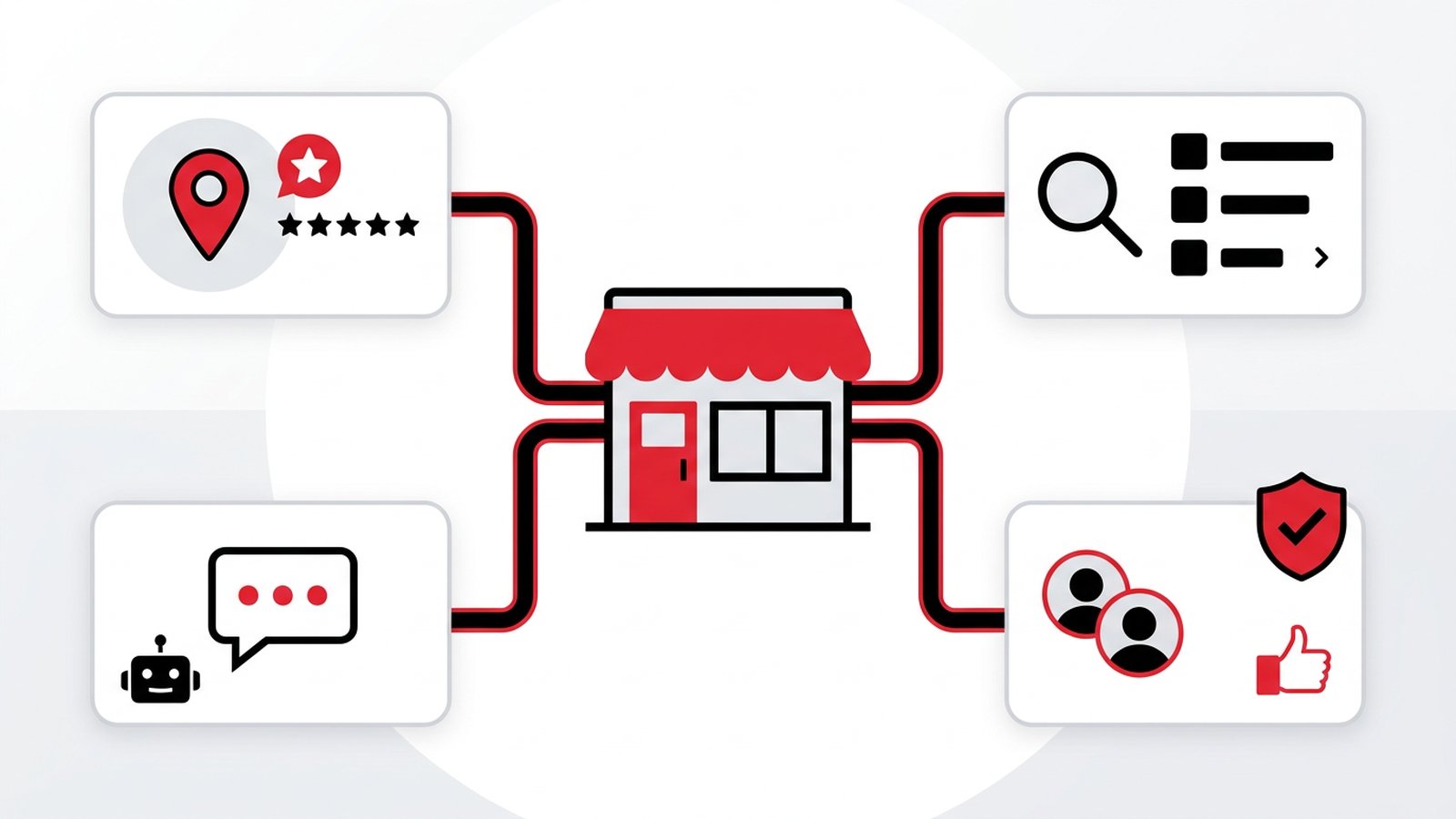
How Do All Four Pieces Work Together?
Each piece answers a different question a customer or an AI tool is asking. When all four agree, you look like the obvious choice. When one is missing, you create doubt.
Here’s what that looks like in practice. For SERVPRO franchise owners in Northeast Pennsylvania, our program combines weekly Google Business Profile optimization and posts, Local Services Ads management, twice-weekly LinkedIn posts for the owners, five Facebook posts a week and a monthly newsletter. Within six months, those clients cut their Local Services Ads cost per lead in half and increased qualified organic leads by 30%. Those results are specific to that client program, but the principle carries over: the channels reinforce each other.
We’ve seen the same compounding effect in pest control. Across three pest control clients, combining SEO, GEO and digital PR averaged +60% qualified organic traffic and +50% revenue within six months.
What Should a Local Business Do Every Week?
You don’t need a big team. You need a routine. This is the simple version we give owners who want to start on their own.
If that list feels like a second job, you’re not wrong. That’s exactly why we built our Hyperlocal Lead Generation program, which covers SEO, GEO, Google Business Profile and social as one system. Restoration franchise owners can see the full SERVPRO franchise marketing program, and home service companies can start with our home services SEO and GEO page.
What Mistakes Make Local Businesses Invisible to AI?
Most local businesses aren’t missing from AI answers because they’re bad at their jobs. They’re missing because their online footprint is thin, outdated or inconsistent.
- Treating Google as the only channel. BrightLocal’s data shows people bounce between Google, social, AI and review sites before deciding.
- A website that doesn’t explain anything. A home page with a phone number and a slogan gives AI tools nothing to quote. Every core service and main town deserves a page that answers real questions.
- Social pages that went quiet. A Facebook page with no posts since last year looks like a business that might be closed.
- An owner who’s invisible. AI tools and customers both look for real people with real expertise. Your name, photo and story should be on your website and LinkedIn.
- Inconsistent business details. Old phone numbers, past addresses and duplicate listings confuse AI tools fast.
- Chasing one AI answer. AI recommendations shift from one run to the next. Measure the trend over months, not one screenshot.
Want to see where you stand? Start with a free audit and we’ll show you what Google, ChatGPT and your customers see when they look you up. For deeper reading, see why GEO is the new map pack and our Google Business Profile optimization checklist.
FAQs
What is GEO for a local business?
GEO, or generative engine optimization, is making your business easy for AI tools like ChatGPT, Gemini and Google’s AI Mode to find, understand and trust. The goal is getting named when someone asks an AI tool who to hire in your area.
Does GEO replace local SEO or my Google Business Profile?
No. AI tools rely on the same sources Google does, especially your Google Business Profile, website and reviews. GEO builds on local SEO; it doesn’t replace it.
Do customers really use AI to find local businesses?
Yes. BrightLocal found 45% of consumers used AI tools for local business recommendations in 2026, up from 6% a year earlier. Most still verify on Google and social media before calling.
Why does Facebook matter for local search?
Facebook is one of the most common places people check reviews and recommendations, and 39% of people who started a search on an AI tool went on to check social media. Regular, real posts show you’re active and trustworthy.
Should a local service business owner post on LinkedIn?
Yes, if you want AI visibility. Semrush found LinkedIn is the second most-cited domain in AI search, and most cited LinkedIn content on ChatGPT and AI Mode comes from individual members. Two useful posts a week builds a record of expertise.
How long does it take to see results?
Most businesses see Google Business Profile and review improvements within weeks, while SEO and AI visibility usually build over three to six months. Our SERVPRO clients in Northeast Pennsylvania saw half the Local Services Ads cost per lead and 30% more qualified organic leads within six months.