Your Google Business Profile is the single highest-leverage free asset your service business owns. It decides whether you appear in the local pack (the map with three business listings at the top of local Google results), and in 2026 it also feeds something bigger—AI search.
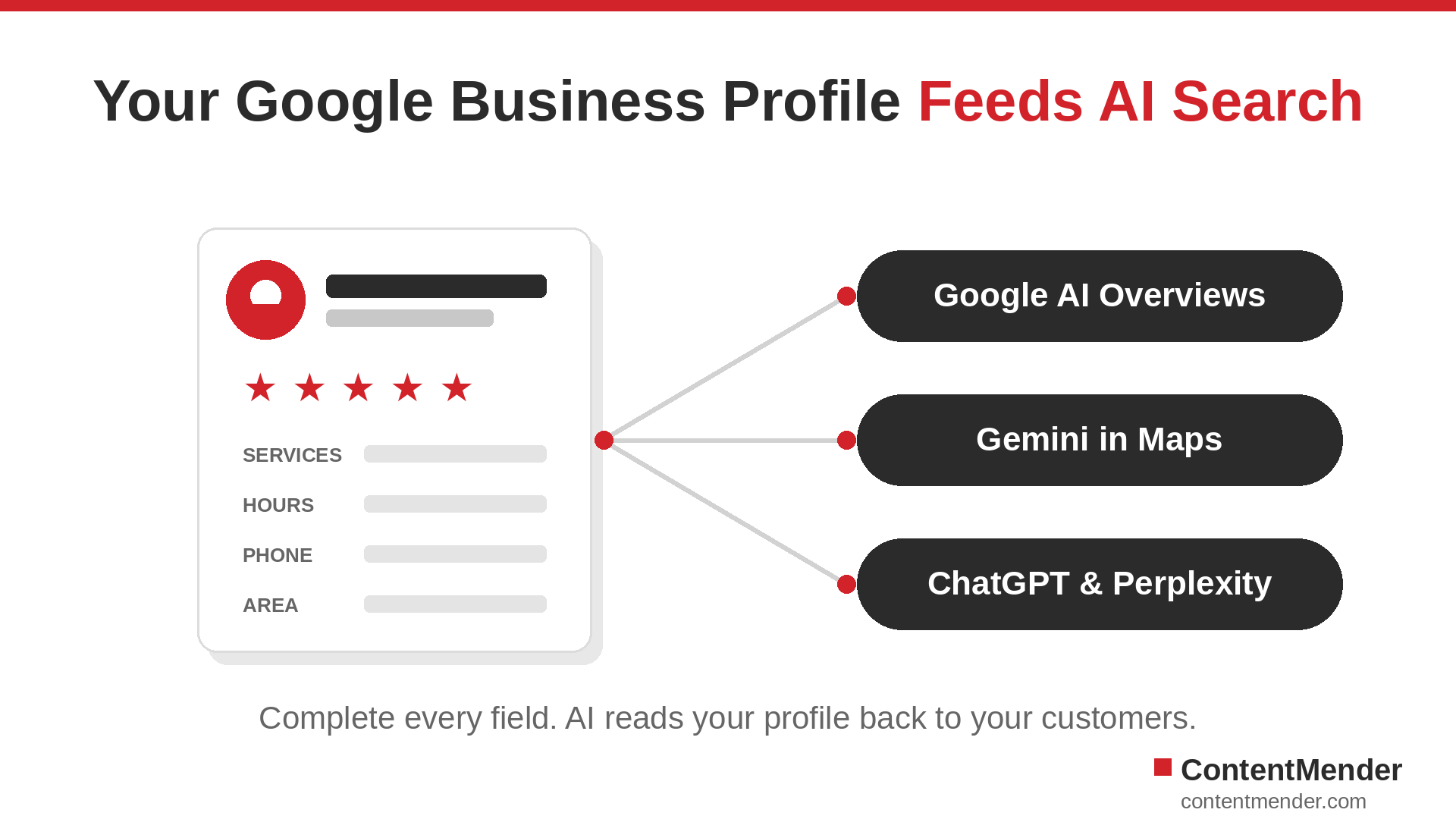
When someone asks Google’s AI Overviews, Gemini, Claude, or ChatGPT, to name the big AI search engines, for “a reliable plumber near me” or “ethical bat removal,” those tools pull business details from the same core source: your GBP data, your reviews, and your listings. If your profile is thin or outdated, AI tools have nothing accurate to cite, and they recommend your competitor instead.
Although this knowledge is well-known across many marketing agencies, smaller business are still clueless, creating one of the most lucrative organic opportunities possible.
For example, BrightLocal research found that only about 35% of small businesses have a claimed Google Business Profile. Work through this checklist, and you are ahead of roughly two-thirds of your market before you spend a dollar on ads.
This focus is a huge part of ContentMender’s Hyperlocal Lead Gen service, and this checklist is the starting point of it all.
The 2026 GBP Checklist at a Glance
Check out this list first (or download the PDF version here).
Profile completeness
- Verify ownership and remove old managers
- Set one accurate primary category and all relevant secondary categories
- List every service with a plain-language description
- Complete attributes (payment types, accessibility, service area)
- Confirm hours, holiday hours, phone, and website link
Photos and posts
- Upload 10+ real photos (team, trucks, completed jobs)
- Add new photos monthly
- Publish at least one GBP posts per month
Reviews
- Ask every customer for a review, ideally same-day
- Respond to every review within 24-48 hours (the sooner the better!)
- Never buy, trade, or gate reviews
Messaging
- Turn on messaging only if someone will answer it
AI readiness
- Audit what AI review summaries say about you
- Match GBP services and descriptions to your website wording
- Keep name, address, and phone identical across all listings
Tracking
- Review GBP performance metrics monthly (calls, clicks, directions)
- Set up UTM tagging on your website link
- Track which searches trigger your profile
Risk
- No keywords stuffed into your business name
- No virtual office or fake address
- Document your verification details in case of suspension
1. Profile Completeness: Categories, Services, and Attributes
Your primary category is the strongest ranking signal on the entire profile. “Roofing contractor” and “roof repair service” surface for different searches, so pick the category that matches your highest-value work, then add secondary categories for everything else you do.
List each service individually with a one-sentence plain-language description. These service names help Google match your profile to specific searches, like “water heater replacement,” rather than just “plumber.”
Attributes matter more than most owners think. BrightLocal’s consumer research found 85% of consumers consider the presence of contact information and opening hours an important factor when researching a local business. Missing hours cost you calls.
2. Photos and Posts: A Cadence That Signals You Are Active
Profiles with fresh photos earn more clicks because people want proof that a real, working business sits behind the listing. Skip the stock images. Photos of your team, your trucks, and finished jobs outperform polished graphics.
GBP posts (short updates that appear on your profile) work like a free ad slot. Share a seasonal offer, a completed project, an article, or a service reminder at least once a weel. The habit also signals to Google that the profile is maintained, and stale profiles slowly lose visibility.
3. Reviews: The Workflow That Compounds
Reviews are now your most valuable marketing asset, and the data proves it. A Birdeye study found each additional Google review drives roughly 80 website visits, 63 direction requests, and 16 phone calls over time. Review volume compounds.
Consumer behavior is moving in the same direction. BrightLocal’s 2026 Local Consumer Review Survey found that 41% of consumers now “always” read reviews when browsing local businesses, up from 29% the year before.
Build a simple workflowm, and ask every customer on the day the job finishes, send one text with a direct review link, and respond to every review within 24-48 hours, but the sooner the better. Responses matter for two audiences: the next customer reading them, and the AI systems summarizing them.
One warning: never gate reviews, meaning do not filter customers so only happy ones get the review link. It violates Google’s policies and risks your profile.
4. Messaging
Turn on messaging only if someone on your team will respond within minutes. A profile that shows slow response times converts worse than one with messaging turned off.
5. GBP AI Features: What Changed in 2026, and Why It Matters
This is the section most older checklists miss entirely. Google now uses AI throughout the local search experience, and your profile is the raw material.
Here is what that looks like in practice:
AI review summaries: Google generates a short AI-written summary of your reviews directly on your profile and in Maps. You cannot write this summary. It is assembled from customer feedback. The only way to influence it is a steady flow of detailed, positive reviews that mention specific services.
AI Overviews for local searches: When Google shows an AI-written answer above the traditional results for a search like “best HVAC company in Scranton,” the businesses it names are pulled from profile data, reviews, and local content. A complete, consistent GBP is the price of entry.
Conversational search in Maps and Gemini: People now ask full questions (“who can replace a water heater today and takes credit cards?”) and the AI filters businesses by attributes, services, and hours. Every empty field on your profile is a filter you fail.
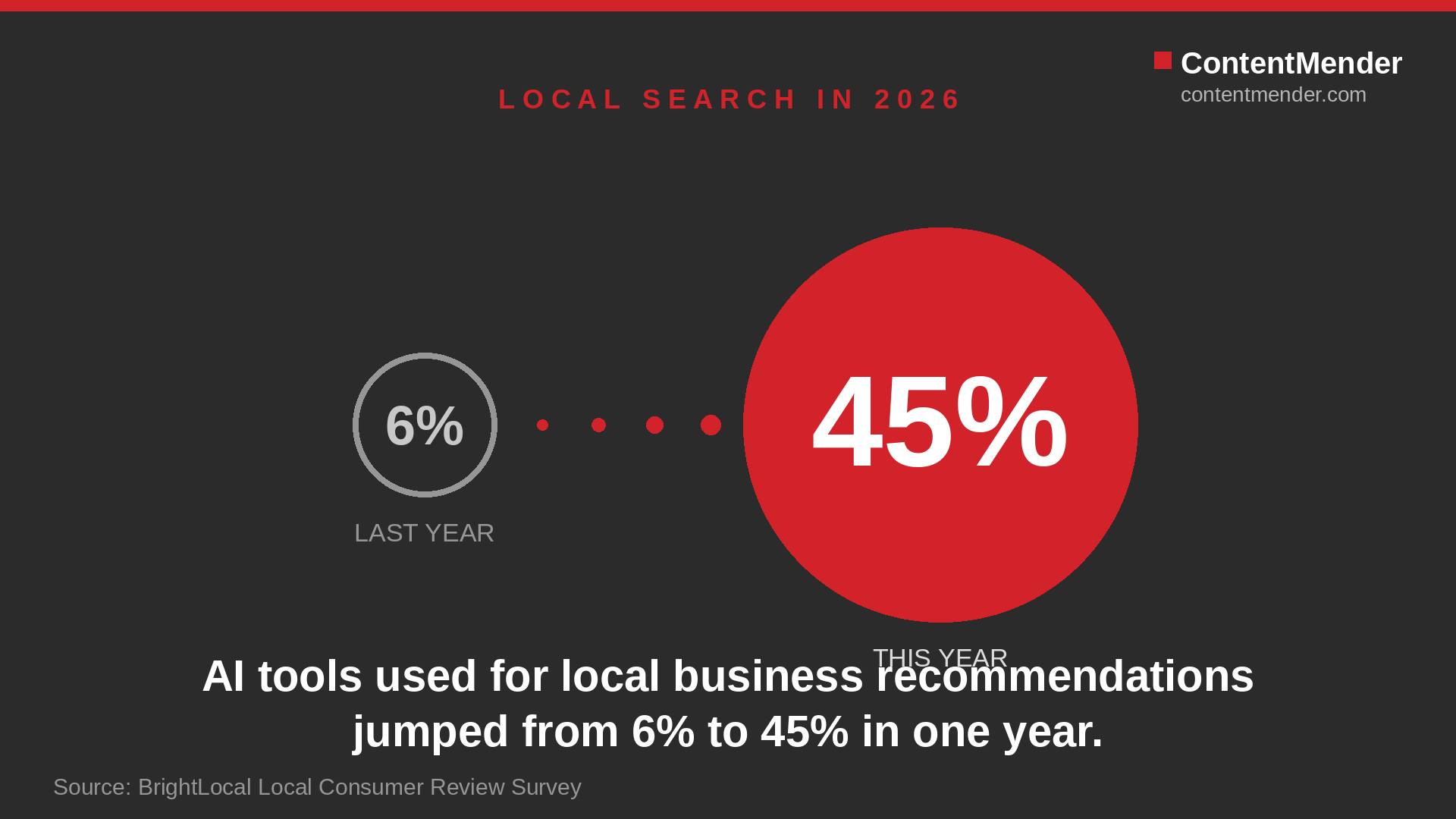
The importance is hard to overstate. BrightLocal found that the use of ChatGPT and similar AI tools for local business recommendations jumped from 6% to 45% in a single year, making AI the third-most-popular source of recommendations.
Your GBP is the most structured, most trusted data source those tools have about you. Treat every field as an answer an AI might read out loud to your next customer.
We cover the feature-level details in our guide to Google Business Profile’s AI features.
6. Tracking GBP Performance
GBP’s built-in performance report shows calls, website clicks, direction requests, and the searches that triggered your profile. Check it monthly.
For context on what a healthy profile produces: industry data shows website visits make up about 48% of all GBP interactions, followed by calls at 21% and direction requests at 9%. Verified profiles average about 200 monthly interactions. If your numbers sit far below that, the checklist items above are where to look first.
Add UTM tags (small tracking codes added to your website link) so your analytics tool can separate GBP traffic from regular Google search traffic. Without them, GBP visits hide inside your organic numbers, and you cannot prove what the profile earns you.
7. Penalties and Suspensions to Avoid
Google suspends profiles without warning, and reinstatement can take weeks. The most common triggers:
- Keyword stuffing the business name: Your profile name must match your real-world business name. “Smith Plumbing” is fine. “Smith Plumbing | Best Emergency Plumber Scranton PA” invites suspension.
- Fake or incentivized reviews: Google’s detection improved sharply with AI. Paid review schemes get profiles wiped.
- Virtual offices and fake addresses: Service-area businesses should hide their address and define a service area instead of listing a co-working space.
- Frequent core edits: Repeatedly changing the name, address, and category within a short window flags the profile for review.
Keep a record of your verification method, business documents, and profile history so you can appeal quickly if a suspension hits.
Put Your Profile to Work
An optimized Google Business Profile earns calls around the clock and feeds every AI tool your customers now use. If you would rather have specialists build and maintain it, our Google Business Profile optimization service handles everything on this checklist, backed by reporting that shows the calls and clicks it produces.
Want the one-page version of this checklist? Grab the downloadable PDF and work through it with your team. [Download the checklist]
FAQs
How often should I update my Google Business Profile?
Check it weekly for new reviews and questions, add photos monthly, and audit categories, services, and hours quarterly. Profiles that sit untouched for months slowly lose visibility in both the local pack and AI results.
Does my Google Business Profile affect AI search results?
Yes. Tools like Google’s AI Overviews, Gemini, and ChatGPT pull local business details from GBP data, reviews, and consistent listings across the web. An incomplete profile gives AI tools nothing reliable to cite, so they recommend competitors with stronger data.
How many reviews do I need to compete locally?
There is no fixed number, but consistency beats totals. A steady flow of recent reviews outperforms a large stack of old ones, since most consumers discount reviews older than three months. Focus on velocity: a few new reviews every month, every month.
Can I optimize my GBP myself, or should I hire someone?
Every item on this checklist can be done in-house if you have the time and check the profile weekly. Most service business owners do not, which is why profiles decay. If yours has sat idle, a managed service pays for itself in recovered calls.
Last updated on July 30th, 2026 at 04:44 pm