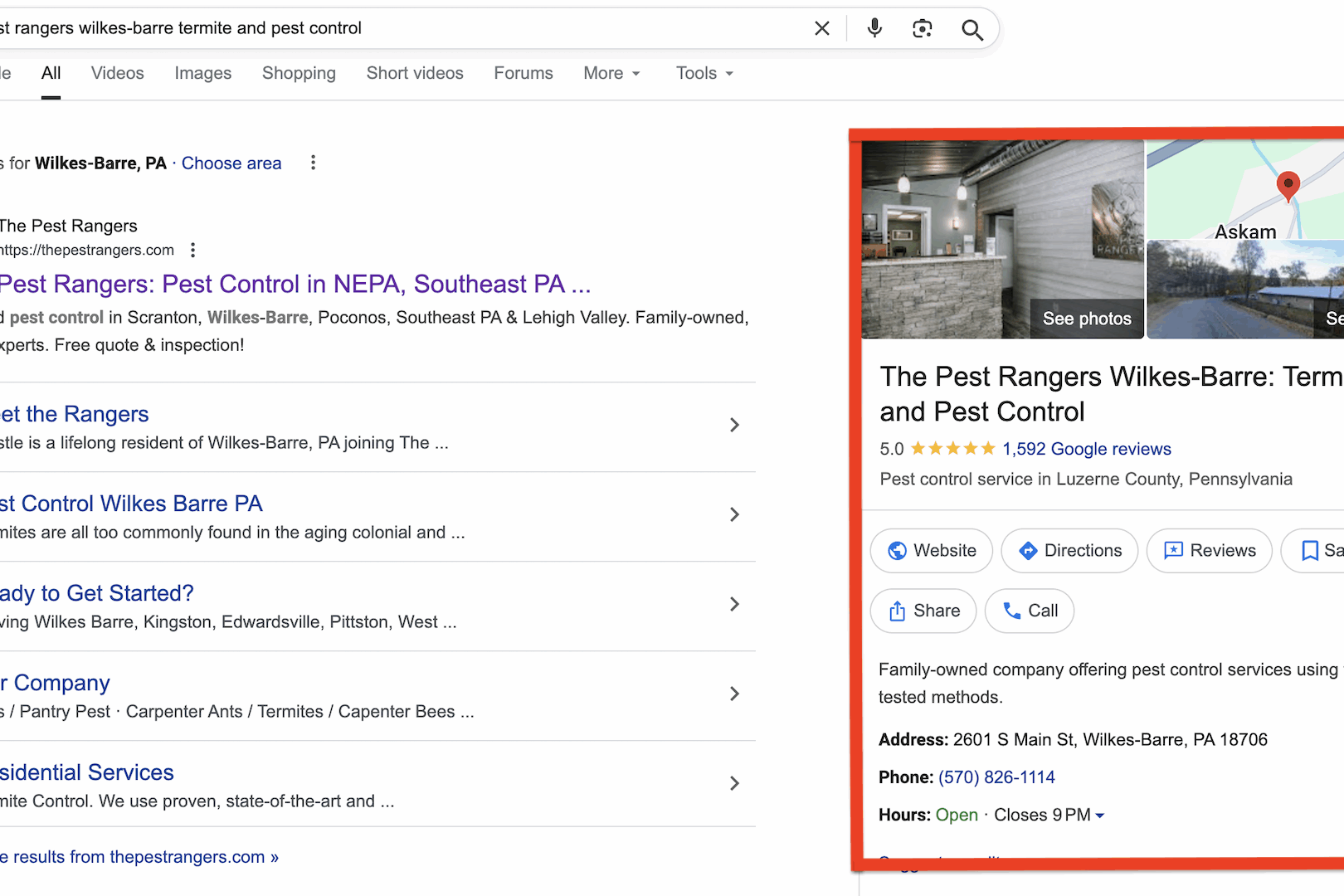
Google Business Profile and Local Services Ads are closely connected, but not in the way many local businesses have been told.
Running Local Services Ads does not buy higher organic rankings. Google maintains separate advertising and organic ranking systems.
However, a well-managed Google Business Profile can improve Local Services Ads performance, while customers acquired through LSA can indirectly strengthen the reviews, reputation, and branded demand that support a business’s broader local-search presence.
Understanding that distinction allows businesses to use both platforms effectively without relying on unsupported claims about rankings.
For businesses using ContentMender’s Hyperlocal Lead Generation services, Google Business Profile and Local Services Ads are essential parts of the same local visibility and lead-generation system.
ContentMender campaigns combine Google Business Profile management, localized website content, review growth, local ranking optimization, and paid lead capture so each channel supports the others, without relying on unsupported claims that advertising spend directly buys organic rankings.
How Often Should You Post on Google Business Profile?
Most local businesses should publish one Google Business Profile post per week.
A weekly schedule keeps the profile current without forcing the business to manufacture content that adds no value. Businesses with frequent promotions, seasonal conditions, community events, project updates, or rapidly changing services can reasonably publish two or three times per week.
Publishing daily is rarely necessary. It can work for businesses with genuinely time-sensitive information, but it should not become an exercise in posting for the sake of posting.
Google does not publish an official maximum number of GBP posts. We recommend a weekly cadence, but remember that Google doesn’t set a limit on the number of Updates a business may publish.
The practical recommendation:
- Publish at least once each week.
- Increase to two posts when there is enough distinct, useful material.
- Use three posts during important seasonal campaigns or limited-time promotions.
- Avoid daily posting unless every update serves a legitimate customer need.
Can Too Many GBP Posts Become Spam?
Posting frequently does not automatically make a Google Business Profile spammy.
Google’s policies focus on the nature of the content rather than a fixed number of weekly posts. Google prohibits repetitive content, including posting the same material multiple times, because repetition reduces the usefulness of information displayed on Google Maps.
A high-frequency strategy becomes risky when it includes:
- Nearly identical wording across multiple posts
- Reused images with only minor changes
- Repeated service and city keywords
- Generic promotional messages with no new information
- Misleading claims or artificial urgency
- Phone numbers inserted directly into post copy
- The same post is distributed across numerous locations without localization
Google specifically describes GBP posts as a way to communicate relevant and timely information to customers. It also prohibits “phone stuffing”, which means placing telephone numbers directly in the post rather than using the approved call button.
The safer principle is simple: publish as often as the business has something useful and distinct to communicate.
Do GBP Posts Improve Local Rankings?
Businesses should not assume that publishing more GBP posts will produce higher map-pack rankings.
After years of testing, ContentMender found no measurable improvement in rankings from adding Google Posts. We recommend using posts to improve conversion rates, highlight services, communicate offers, address customer objections, and guide searchers toward contacting the business.
That does not make posts unimportant.
A customer who has already found a Business Profile may use its posts to judge whether the company is active, relevant, credible, and capable of solving their immediate problem. Posts can support the decision to call, visit the website, request an estimate, or book an appointment.
GBP posts are best treated as conversion assets rather than direct ranking levers.
How Does Google Business Profile Influence Local Services Ads?
Google Business Profile can directly affect how a business appears and performs in Local Services Ads.
Google states that star ratings and the number of reviews affect a provider’s ranking within Local Services Ads. Businesses with stronger ratings and more reviews also tend to stand out and book more work.
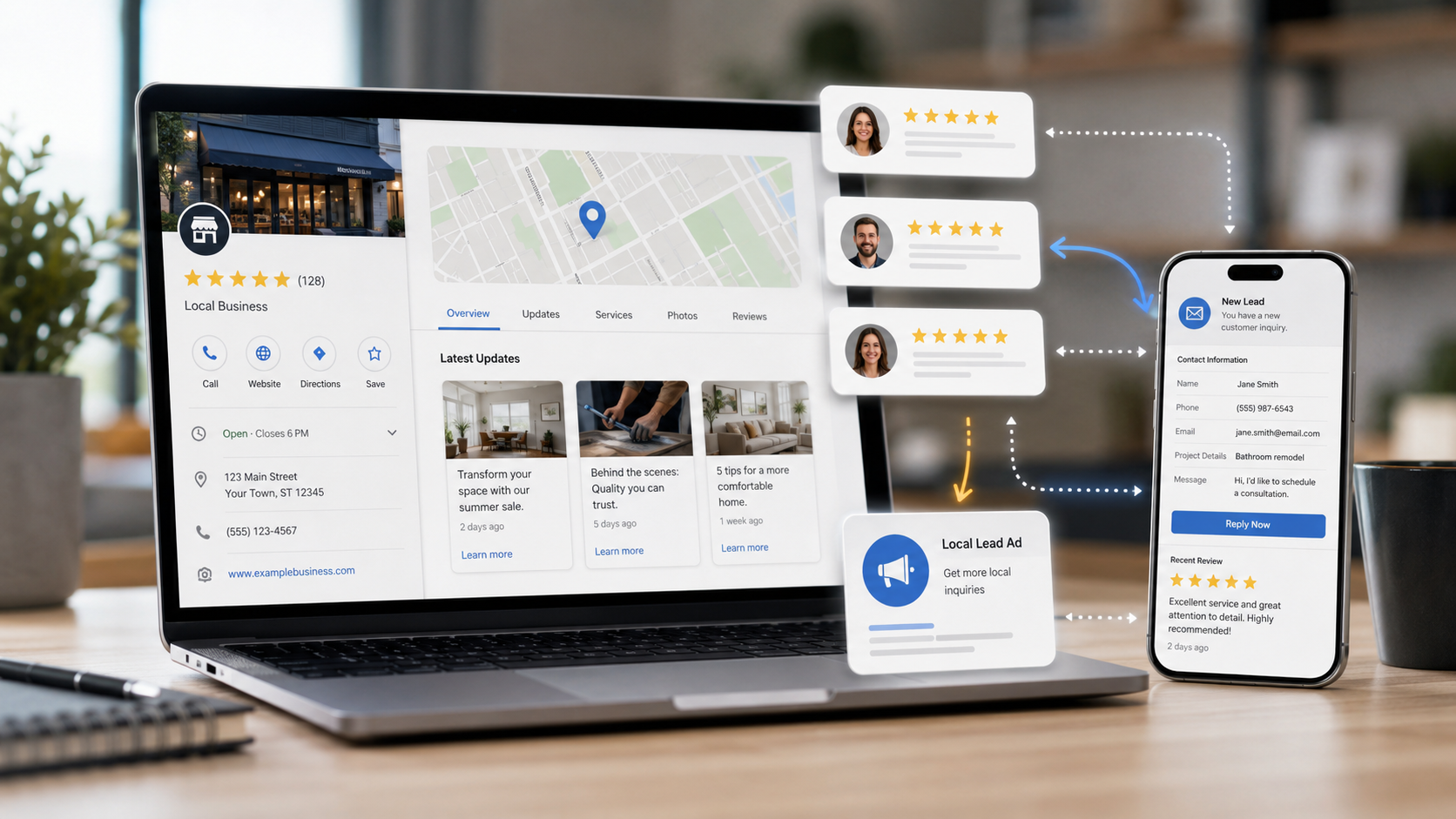
Local Services Ads can display reviews taken from the company’s Google Business Profile.
Google may also use photographs from the Business Profile in the LSA experience, although businesses should manage the images in each platform carefully.
Additional LSA ranking and performance factors include:
- The business’s bid
- Responsiveness to customer inquiries
- The relevance of the service to the search
- Searcher location and search context
- Profile quality
- Review count and star rating
- Business hours and availability
- Photographic quality
Google specifically warns that missed calls can negatively affect responsiveness, and says consistently fast responses may improve LSA ranking.
A neglected GBP can therefore weaken the review and trust signals displayed in LSA, even though the two products have separate management and auction systems.
Does Local Services Ads Spending Improve Organic Rankings?
No direct organic ranking benefit has been documented by Google.
Google explicitly states that investment in paid search does not affect organic search rankings, and that its advertising and search businesses are kept separate.
Google makes a similar statement about local search. Businesses cannot request or pay for better local rankings. Local results are primarily based on relevance, distance, and prominence.
So increasing an LSA budget should not be presented as a direct map-ranking strategy.
However, LSA can create indirect benefits that strengthen the overall local-search system.
The Indirect LSA and GBP Flywheel
Consider what happens when an effective LSA campaign produces a qualified lead:
- A customer discovers the company through Local Services Ads.
- The company responds quickly and completes the work.
- The customer is asked to leave an honest Google review.
- The review appears on the Google Business Profile.
- The stronger review profile improves customer confidence.
- The reviews may improve LSA ranking and conversion.
- Additional legitimate reviews may also strengthen the business’s local prominence.
Google confirms that review count and positive ratings can help local ranking.
This is not LSA spend directly influencing organic rankings. It is advertising that generates real customers, whose subsequent reviews and branded activity improve signals associated with the business.
That distinction matters.
Why an Always-On LSA Budget Can Still Make Sense
Maintaining a modest LSA budget can be strategically sound when the campaign consistently produces profitable work.
An always-on campaign can:
- Capture high-intent searches throughout the month
- Maintain lead-flow continuity
- Generate new customers who may later leave reviews
- Provide current data about service and geographic demand
- Keep the company visible when organic rankings fluctuate
- Protect branded searches through direct business search
- Help the company maintain response-time discipline
- Reduce dependence on any single traffic source
Google’s direct business search feature allows an LSA to appear when someone searches specifically for the company or brand.
In that case, the business’s ad is the only Local Services Ad shown, and Google says advertisers are charged only for leads from new customers.
However, the budget must still be commercially justified. A small spend that generates no impressions or leads does not improve organic performance merely because the campaign remains active.
The appropriate budget is the lowest amount that produces sufficient auction participation, qualified leads, and useful performance data while maintaining an acceptable cost per booked job.
The Correct Strategy
The best local-search strategy does not try to use LSA as a shortcut for organic rankings.
Instead:
- Optimize the Google Business Profile for relevance, accuracy, and conversion.
- Publish one useful GBP post per week.
- Generate legitimate reviews consistently.
- Respond to LSA calls and messages quickly.
- Keep LSA active as long as unit economics remain profitable.
- Track leads through completed revenue, not merely calls.
- Treat organic, GBP, and LSA as separate channels that reinforce the same business reputation.
Google Business Profile helps Local Services Ads by supplying reputation and business-quality signals. Local Services Ads can indirectly help the Business Profile by driving customer acquisition, reviews, branded demand, and additional real-world prominence.
That is the relationship businesses should build around.
For a broader implementation framework, review ContentMender’s local SEO ranking factors guide and its analysis of how GEO and local SEO work together. These resources show how GBP, local content, reviews, website signals, citations, and AI-search visibility fit into a complete Hyperlocal Lead Generation campaign.
FAQs
How often should a local business post on Google Business Profile?
One useful post per week is the strongest default for most local businesses. Businesses with distinct promotions, seasonal updates, events, completed projects, or time-sensitive service information can publish two or three times per week.
Daily posting should be reserved for businesses that genuinely have new information to communicate.
Will Google penalize a business for posting too many times per week?
Google does not publish a numerical weekly posting limit. Frequency alone is not the violation.
The risk comes from repetitive, duplicated, misleading, low-value, keyword-stuffed, or otherwise policy-violating content. Prioritize usefulness and originality over volume.
Do Google Business Profile posts directly improve Map Pack rankings?
Google does not identify post frequency as one of its three primary local ranking factors, and third-party testing has not established a reliable direct ranking lift from posts.
Posts are better used to improve conversion, communicate timely information, and give prospects another reason to contact the business.
Does spending money on Local Services Ads improve organic Google rankings?
No direct ranking benefit is supported by Google. Google states that paid-search investment does not affect organic rankings.
LSA can still create indirect benefits by generating customers, reviews, branded searches, and engagement that strengthen the business’s broader local presence.
Which Google Business Profile signals influence Local Services Ads?
Reviews are the clearest documented connection. Google states that star rating and review count influence LSA ranking.
Business information, hours, service areas, profile quality, responsiveness, and photos can also influence eligibility, presentation, conversion, or ad ranking within the LSA system.
Should every service business keep Local Services Ads running continuously?
Only when the economics are sound. An always-on budget can preserve high-intent visibility, lead-flow continuity, review opportunities, and current demand data.
However, spend should be reduced or paused when lead quality, booked-job rate, gross profit, or operational capacity makes the campaign unprofitable.
What is the best way to measure GBP and LSA together?
Track each lead from source through booked appointment, completed job, revenue, gross profit, and review acquisition. GBP activity should be measured through calls, website clicks, direction requests, bookings, and conversion behavior.
LSA should be measured through valid leads, response time, booked rate, revenue, cost per booked job, and customer lifetime value.
Can the same GBP post be used across multiple locations?
The core campaign theme can be reused, but each location should receive distinct wording, imagery, service details, and local context. Publishing the same post repeatedly across locations creates a low-value footprint and can conflict with Google’s prohibition on repetitive content.