When someone asks ChatGPT, Perplexity, Claude, or Google’s AI Overviews for “the best pest control company near me,” the AI does not guess. It assembles an answer from a short list of trusted sources: your Google Business Profile, your reviews, your business listings across the web, and content on your website it can quote directly.
Showing up in AI search is not a mystery, and it is not luck. Businesses that feed those sources clean, consistent, quotable information get recommended. Businesses that do not are invisible, no matter how good their work is.
This guide shows exactly where AI tools pull local answers from, how this differs from traditional local SEO, and the seven moves to make this quarter to get cited.

Why AI Search Matters for Local Businesses Now
The shift happened faster than almost anyone predicted. BrightLocal’s Local Consumer Review Survey found that the use of ChatGPT and similar AI tools for local business recommendations jumped from 6% to 45% in one year.
AI is now the third most popular source of local business recommendations, and separate BrightLocal research shows about 40% of consumers actively use generative AI within their search habits.
Here is why the change is structural, not a fad. AI answers now sit above the traditional results on Google itself. AI Overviews (the AI-written summaries at the top of many Google searches) answer the question before a single blue link appears.
ChatGPT added live web search. Perplexity built its entire product on cited answers. Gemini now handles conversational questions inside Google Maps.
For a growing share of your customers, the AI’s shortlist is the search result. If the AI names three companies and yours is not one of them, the customer may never scroll far enough to find you.
The good news for service businesses is that your national competitors cannot buy their way into these answers. AI recommendations are assembled from organic signals, and organic signals are exactly what a well-run local business can build.
Where AI Tools Pull Local Answers From
Large language models (the technology behind tools like ChatGPT and Gemini) build local recommendations from a handful of sources. Think of it as a funnel of trust.
- Your Google Business Profile: The most structured, most trusted data AI has about your business: categories, services, hours, service area, photos, and attributes. Google’s own AI features read it directly, and other tools reach it through search and Maps data.
- Your reviews: AI does more than count stars. It reads review text and summarizes it. Reviews that mention specific services (“replaced our water heater same day”) give AI concrete evidence to repeat. Thin reviews (“great job!”) give it nothing.
- Citations and NAP consistency: Citations are online mentions of your business name, address, and phone number (NAP) on directories and other websites. AI systems cross-reference these to confirm you are a real, established business. Conflicting addresses or old phone numbers erode that confidence.
- Structured, quotable website content: AI tools lift answers from pages that answer questions directly: clear question-style headings, concise answers in the first sentence or two, comparison tables, and FAQ sections. Schema markup (code added to your website that labels your content so machines can read it without guessing) makes extraction even easier.
- Third-party mentions: “Best of” lists, local press, industry directories, and Reddit threads all feed AI training and retrieval. When multiple independent sources name your business, AI treats that agreement as proof.
Notice what is missing from that list? Ad spend. Every source above is earned.
GEO vs. Traditional Local SEO
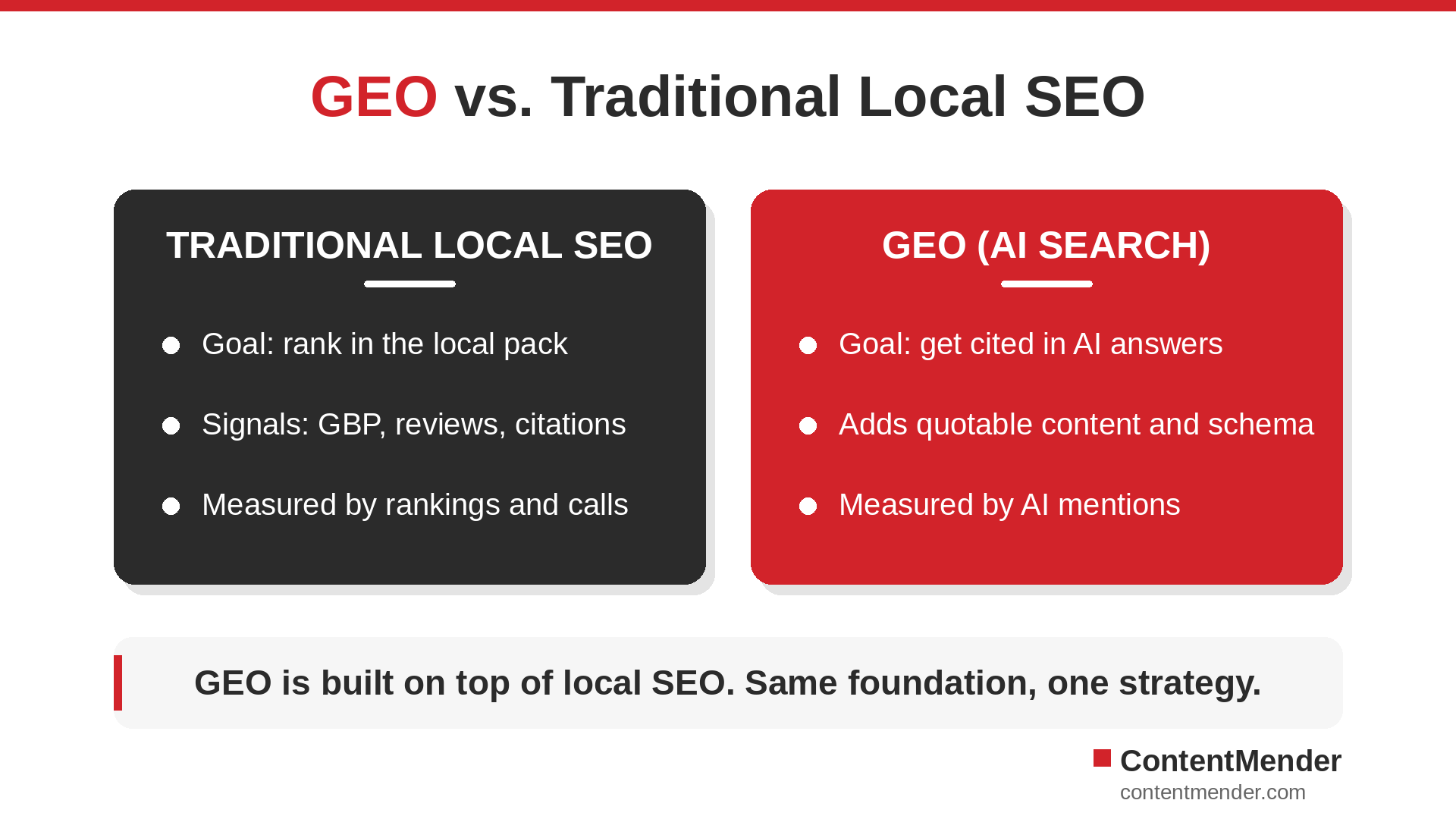
GEO stands for Generative Engine Optimization, the practice of making your business easy for AI systems to find, understand, and cite. It is not a replacement for local SEO. It is built on top of it.
| Traditional Local SEO | GEO (AI Search) | |
|---|---|---|
| Goal | Rank in the local pack and organic results | Get named and cited in AI-generated answers |
| Where you appear | Google Maps, local pack, blue links | AI Overviews, ChatGPT, Perplexity, Gemini |
| Key signals | GBP, reviews, citations, links, on-page SEO | Same foundation, plus quotable content, structured data, and third-party mentions |
| Content style | Keyword-targeted pages | Direct answers, tables, FAQs built for extraction |
| How you measure it | Rankings, traffic, calls | AI mentions, AI referral traffic, branded search lift |
| What breaks it | Thin content, weak reviews | Inconsistent data, nothing worth quoting |
The overlap is the headline. Roughly 80% of the work is shared, which is why businesses with strong local SEO foundations adapt to AI search quickly. We break down the differences further in our guide to GEO for local search.
7 Things to Do This Quarter to Get Cited by AI
1. Complete your Google Business Profile: Every field. Categories, individual services with descriptions, attributes, hours, photos. Empty fields are filters you fail when someone asks AI a specific question. Our GBP optimization guide walks through each section.
2. Build review velocity, and get specific: Ask every customer for a review the day the job finishes, and prompt them to mention the service performed. A steady monthly flow of detailed reviews gives AI fresh, quotable evidence.
3. Fix your NAP consistency: Audit your listings and make your name, address, and phone number identical everywhere. This is tedious, unglamorous work, and it is foundational to AI trust.
4. Add FAQ content and schema markup: Put a genuine FAQ section on your key pages, answering the questions customers ask most. Mark it up with FAQPage schema so machines can parse it cleanly.
5. Restructure content for direct answers: Turn headings into questions and answer them in the first two sentences. Add comparison tables. AI lifts passages, so write passages worth lifting.
6. Earn third-party mentions: Pitch local press, pursue legitimate industry awards and directories, and show up helpfully where your customers ask for recommendations. Independent mentions are the votes AI counts.
7. Keep everything fresh: Add visible updated dates, refresh stats, and revisit your top pages quarterly. AI systems favor current information, and so do the customers reading the answer.
How to Track AI Visibility
You cannot install a rank tracker for ChatGPT and other AI search engines, but you can measure real signals.
Run monthly prompt tests: Ask ChatGPT, Perplexity, and Gemini the questions your customers ask (“best [service] in [city]”) and log whether you are named. Track it in a simple spreadsheet.
Watch AI referral traffic: In Google Analytics, check referral sources for chatgpt.com, perplexity.ai, and gemini.google.com. Small numbers today, growing every quarter.
Monitor branded search: When AI names your business, people Google you next. A lift in branded searches often follows AI visibility.
Ask new customers directly: Add “How did you hear about us?” to your intake process and include AI tools as an option. This catches recommendations analytics never sees.
For the broader playbook, see our guide on how to show up in ChatGPT and generative AI results.
Get Found Everywhere Your Customers Search
AI search rewards the same thing Google always has: being the clearly documented, well-reviewed, consistently referenced business in your market.
ContentMender’s Hyperlocal Lead Generation service builds that visibility across Google, Maps, and AI search, with no contracts and no cookie-cutter tactics. Schedule a free consultation and we will show you exactly where AI tools currently rank your business against your competitors.
FAQs
Can I pay to appear in ChatGPT or AI Overviews recommendations?
No. AI-generated local recommendations are assembled from organic signals: your Google Business Profile, reviews, listings, and content. That is good news for local businesses, because the playing field rewards fundamentals rather than ad budgets.
How long does it take to show up in AI search results?
Businesses with strong local SEO foundations often see AI mentions within a few months of structuring their content for extraction. Starting from scratch, expect six months or more of consistent work on reviews, listings, and content before AI tools reliably cite you.
Does AI search replace traditional local SEO?
No. AI search is built on top of local SEO. The same signals that rank you in the local pack (a complete GBP, reviews, consistent citations, quality content) are the raw material AI tools use to generate recommendations. Skip the foundation and there is nothing for AI to cite.
Which AI tools matter most for local businesses?
Google’s AI Overviews and Gemini matter most because they sit inside the search and Maps experience your customers already use. ChatGPT and Perplexity follow, and both are growing fast as recommendation sources.