2026 is the year of mass consumer adoption of AI.
Close to 10% of the world’s adult population used ChatGPT regularly in 2025. Today, over 800 million people use it weekly, and companies across the digital sphere are awakening to the phenomenon of “dark traffic”: users who engage with your brand but don’t click on your website.
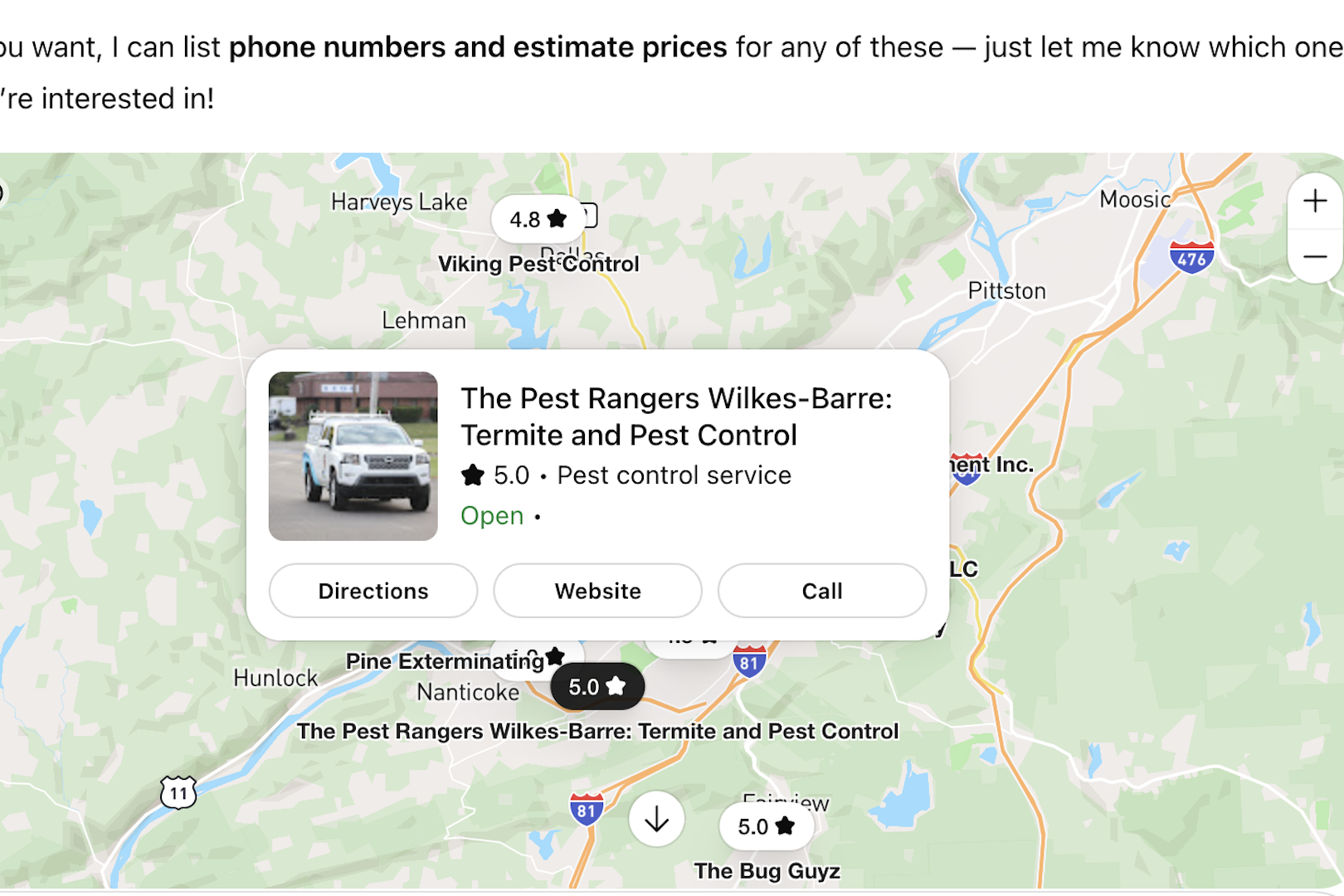
No industry is untouched by this transformation. AI chatbots like ChatGPT, Gemini, Perplexity, and Claude have evolved to include traditional search features, such as local service-based maps, product results, and directory listings for local businesses, alongside their informational queries.
Content retrieval plays a foundational role in how these Large Language Models (LLMs) parse and display information to users, but these platforms require clearer structures and more context to function at their best.
Writing content with concise answers, well-structured sections that can stand alone, and rich markup is essential for discovery. However, best practices extend well beyond the written word to your website’s backend and overall brand presence.
We have pivoted our Hyperlocal and Hyperfocused Lead Generation strategies to help our clients get discovered and rank high in generative engine optimization (GEO) and AEO (Answer Engine Optimization, like Google’s AI results), achieving great success in 2025 by following the best practices outlined below.

How LLMs Understand Content
These LLMs understand content by extracting clear, self-contained answers from trusted sources, then synthesizing them into a single response rather than ranking pages as a list of links.
AI search engines don’t “rank pages” the same way Google’s traditional algorithm does. Instead of returning a list of links, they generate answers by pulling from multiple trusted sources, summarizing them, and presenting a single response.
That process depends on three core factors:
- Retrievability: Can the AI easily extract clear, self-contained answers from your content?
- Trust: Does your site show signals of expertise, authority, and real-world credibility?
- Relevance: Does your content directly answer the user’s question with minimal interpretation?
Unlike classic SEO, AI search doesn’t necessarily demand or retrieve from the highest-quality page. Rather, it retrieves an answer from a page it trusts and understands clearly.
If your content requires inference, assumptions, or heavy interpretation, it’s less likely to be selected.
The process of ranking and optimizing for generative AI platforms and agents is known as generative engine optimization (GEO).
GEO vs. SEO: What Are the Primary Differences?
GEO and SEO differ substantially in how they index, organize, and serve results.
Whereas traditional SEO indexes and organizes content in a search engine results page (SERP), GEO provides answers to queries within its native platform, with some citations listed for context.
Platforms like ChatGPT and Perplexity do provide results similar to traditional SERPs, but answers depend heavily on the query intent.
This process also eliminates much of the need for users to click and navigate to your website. In many cases, users can get the answers they need about your brand or products directly in their chat and will either visit or call your business without ever navigating to your website.
Traditional search engines also still heavily rely on user signals, keywords, and backlinks to rank and organize content. In contrast, AI chatbots tend to pull information from easily interpreted content within their index.
This changes the way we fundamentally approach and write content to rank for search engines and GEO-specific platforms.
SEO vs. GEO Differences Table
The following table illustrates the fundamental differences between SEO and GEO optimization strategies at a categorical level.
| Category | Traditional SEO | Generative Engine Optimization (GEO) |
| Definition | The process of optimizing content to rank in traditional search engine results pages (SERPs). | The process of optimizing content to be surfaced, summarized, or cited by generative AI platforms and agents. |
| Result Format | Displays ranked web pages in a SERP that users must click through. | Provides direct answers within the AI platform, often with limited citations. |
| Content Delivery | Users navigate to websites to consume information. | Users often get answers without visiting a website at all. |
| User Interaction | Click-based discovery and navigation. | Conversational, intent-driven responses. |
| Platforms | Google, Bing, and other traditional search engines. | Chat-based and AI-driven platforms such as ChatGPT and Perplexity. |
| Indexing & Organization | Content is indexed and ranked based on keywords, backlinks, and user behavior signals. | Content is pulled from easily interpreted, structured, and authoritative sources within an AI’s index. |
| Ranking Signals | Heavy reliance on keywords, backlinks, technical SEO, and engagement metrics. | Emphasis on clarity, context, semantic meaning, and machine-readable content. |
| Click Dependency | Requires users to click through to a website for answers. | Often eliminates the need for clicks; users may contact or convert without visiting the site. |
| Query Handling | Mostly keyword-driven with some semantic understanding. | Strongly dependent on user intent and conversational context. |
| Content Strategy Impact | Focuses on optimizing pages to rank higher than competitors. | Focuses on writing content that AI systems can easily interpret, summarize, and cite. |
How to Optimize Content for Generative AI
1. Write in Complete, Extractable Answers
AI systems don’t infer meaning the way humans do. They extract information by identifying self-contained statements that fully answer a question without requiring surrounding context.
Content performs best in generative results when each paragraph or sentence delivers a complete idea on its own.
The goal is to chunk content to create easily extractable snippets that mirror the type of answers you would see in Google’s AIO or a ChatGPT response.
Avoid all fluff and state the answer to header questions clearly and early. For example, if a section explains what radon testing is, say exactly what it measures, how it works, and when it’s used in the first few sentences. This allows AI to lift the information directly without guessing or paraphrasing inaccurately.
Writing this way also improves human clarity. Readers don’t need to hunt for answers, and AI systems don’t need to reconstruct meaning from multiple fragments.
2. Use Clear Hierarchy and Predictable Formatting
Organize content and web documents with a clear hierarchy using headers in their appropriate order.
- H1 for the primary topic
- H2s for major sections
- H3s for supporting ideas.
Use a predictable hierarchy, keep paragraphs concise and focused on a single concept.
Web content should start broad, answering the most important questions, such as “What Is Radon?” and then gradually become more detailed and action-oriented, such as “How to Mitigate Radon in Homes.”
URL structure also plays a significant role, as building out parent-child page relationships between content, such as “www.example.com/parent-topic/child-subtopic,” will also help LLMs understand your website hierarchically and organize accordingly.
Bonus: Create an LLM.txt file, which operates like a traditional sitemap. This file allows you to organize your text document in descending order by its most important pages for LLMs to understand.
3. Tag Content with Structured Data
Schemas such as Article, FAQ, LocalBusiness, Product, ServiceReview, and Person clarify relationships among entities, authors, services, and locations. This makes it easier for AI systems to understand who you are, what you offer, where you operate, and why your content is authoritative.
When structured data aligns with the page’s visible content, it reinforces trust and consistency across traditional search engines, AI Overviews, and generative tools like ChatGPT and Perplexity. For local and service-based businesses, this also helps AI accurately associate your content with geographic relevance, reviews, and real-world outcomes.
The more precise and complete your structured data is, the less guesswork AI systems have to do.
4. Organize Content with FAQs and Tables
FAQs and tables present information in discrete, well-defined blocks that can be extracted without interpretation.
FAQs work because each question-and-answer pair mirrors how users interact with AI. Tables work because they clearly compare variables, options, or outcomes in a way that minimizes ambiguity.
When used correctly, these formats improve both comprehension and extractability. They allow AI to pull precise answers or comparisons while also helping readers make faster decisions.
5. Implement Author Tags
Author attribution signals accountability, expertise, and real-world experience.
Including a named author, short bio, and relevant credentials helps establish trust. This is particularly important for topics involving health, finance, legal matters, or high-stakes decisions. Content tied to a credible individual is less likely to be treated as generic or unreliable.
Author tags also help AI associate content with consistent expertise over time, increasing the likelihood that future content from the same source is trusted and reused.
6. Refresh Content Regularly
AI systems favor content that reflects current knowledge. Outdated information increases the risk of misinformation, which generative engines are designed to avoid.
Refreshing content doesn’t require constant rewrites. Updating statistics, clarifying guidance, adding recent examples, or refining language for clarity all signal that content is actively maintained.
Regular updates demonstrate ongoing expertise and reduce uncertainty for AI systems deciding which sources to trust. Over time, this maintenance compounds, strengthening visibility across both traditional and AI search results.
7. Make Content Easy to Crawl and Discover
Generative engines rely on web crawlers, indexes, and retrieval systems that favor simplicity and transparency.
Follow these tips to make your website easier to crawl and understand for LLMs:
- Don’t block LLMs from crawling your website
- Avoid client-side JavaScript rendering
- Don’t hide content behind expandable menus or walls of texts
- Use clear canonicals and avoid PDFs/duplicate content
- Create an LLM.txt file for LLMs to easily crawl and categorize your content
Many LLMs like ChatGPT also use traditional search indexes like Bing, so many of the same strategies that work for conventional SEO will also translate to GEO success.
The brand-new world of AI search promises to disrupt the traditional search model completely, but with the right optimization strategy in place, you can capture more leads and brand awareness than ever.
Since AI is still relatively in its infancy, there has never been a better time to capitalize on this opportunity than now.
FAQs
What is Generative Engine Optimization (GEO)?
GEO is the practice of structuring content so AI systems can extract, trust, and feature it in generated answers rather than traditional search listings.
Is GEO replacing SEO?
No. GEO builds on SEO. Strong SEO foundations help AI discover your content, while GEO determines whether it gets used in answers.
What type of content works best for GEO?
Clear, factual, well-structured content that answers specific questions directly performs best in AI search environments.
How long does it take to see GEO results?
Some content can appear in AI results within weeks, especially for niche or local queries. Broader authority builds over time.
Do backlinks still matter for GEO?
Yes, but indirectly. Backlinks contribute to trust signals that AI systems use when evaluating source reliability.
How do I know if AI is citing my content?
Test relevant prompts in AI tools, monitor referral traffic from AI platforms, and track branded search growth over time.
Does local content help with GEO?
Absolutely. AI often favors locally grounded expertise because it reduces the risk of giving generic or inaccurate advice.
Should every page be optimized for GEO?
Not necessarily. Focus GEO efforts on educational, decision-stage, and FAQ-driven content where AI answers are most common.